
Risk Warning: This article is for informational and risk education purposes only and does not constitute investment advice. GROVE, USDS, sUSDS, RWA credit products, and DeFi protocols carry smart contract, governance, liquidity, regulatory, and underlying asset risks. Before any action, please independently verify contract addresses, official documentation, audit reports, yields, TVL, redemption rules, and the legal requirements of your jurisdiction.
I. Why GROVE Is Not "Just Another DeFi Lending Protocol" --- The Institutional Credit Layer Positioning Within the Sky Ecosystem
Many newcomers seeing Grove for the first time will compare it to Aave, Compound, or Morpho as a competing lending protocol. After all, it also involves stablecoins, yield, lending, and credit assets. But this understanding is inaccurate.
Grove is more accurately described as the institutional credit allocation layer within the Sky ecosystem, rather than a general-purpose lending market open to retail users for free deposits and borrows.
The core model of Aave and Compound is: users deposit assets into a pool, other users collateralize assets to borrow, and interest rates fluctuate based on supply, demand, and utilization. The core model of Grove is: taking USDS stablecoin liquidity from the Sky ecosystem and, through governance, vaults, partners, and risk parameters, allocating it to tokenized credit, RWA, institutional-grade assets, and DeFi strategies.
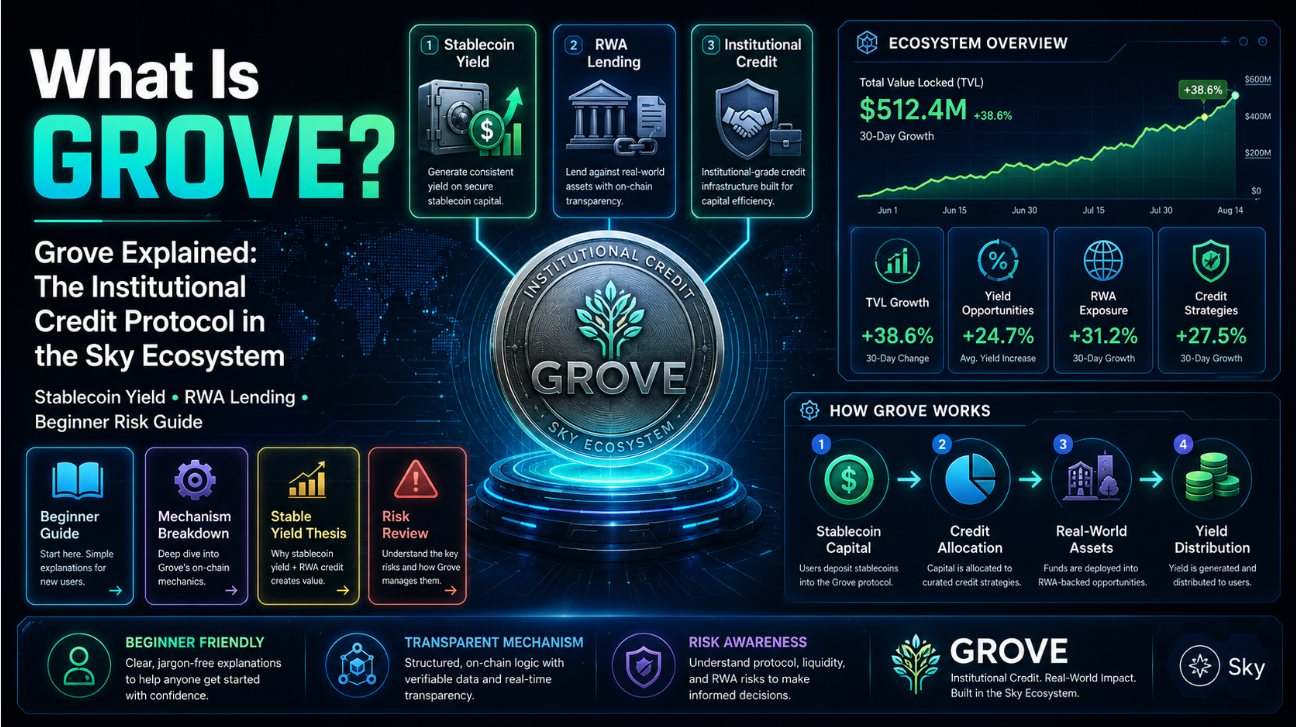
Grove's official website describes itself as "capitalizing the stablecoin economy," and shows its positioning as developing credit, capital markets, and institutional needs within onchain finance. The website also shows Grove's current TVL at approximately $2.58B, with 16 Active Allocations, and lists ecosystem partners including BlackRock, Apollo, Centrifuge, Janus Henderson, Galaxy, Maple, Aave, and Morpho.
What Is the Relationship Between Grove and Sky?
Sky is the former MakerDAO ecosystem. MakerDAO's most important product was DAI, which was later upgraded to the Sky ecosystem, launching a new stablecoin and yield system including USDS, sUSDS, the Sky Savings Rate, and the SKY governance token.
Grove is a Star / Prime Agent within the Sky ecosystem. It is not an independent new public chain, nor is it a completely isolated DeFi protocol; rather, it serves as the institutional-grade credit allocation and RWA capital routing layer within the Sky ecosystem framework.
Grove's official documentation states that Grove operates as a Star within the Sky Ecosystem, serving as Sky's institutional credit allocation layer, routing USDS liquidity into diversified credit strategies through vault-based, non-custodial infrastructure.
So, newcomers can understand it this way:
Sky is the stablecoin and governance base layer, USDS is the capital foundation, sUSDS is the savings yield entry point, and Grove is the infrastructure that allocates this stablecoin capital into institutional credit and RWA scenarios.
Why Does Grove Call Itself an "Institutional Credit Allocation Layer"?
Because the problem it solves is not "retail users borrowing to trade crypto," but rather "how to safely, transparently, and governably allocate onchain stablecoin capital into real-world credit markets."
Traditional DeFi lending mostly relies on over-collateralization. For example, you collateralize ETH and borrow USDC; when collateral drops to a certain level, it is liquidated. This model works for crypto assets, but it is not well-suited for real-world credit in traditional finance. Real-world credit markets involve borrower creditworthiness, legal contracts, asset managers, custodians, payment priority, default handling, ratings, maturity structures, and cash flows.
Grove's positioning is to bring these complex institutional credit structures onchain in a more programmable, more transparent, and more DeFi-composable way. The official website describes Grove Allocator as institutional-grade onchain capital allocation infrastructure, featuring non-custodial vaults, cross-chain strategies, rate limiters, exposure caps, and governance-enforced parameters.
This is not on the same level as Aave's "open lending pool."
Aave is more like a lending market for DeFi users.
Grove is more like a capital allocation and institutional credit intermediary layer within the Sky ecosystem.
What Does $1.99B Concentrated on Ethereum Tell Us?
Third-party DeFi data platforms show that Grove Finance's TVL is primarily concentrated on Ethereum, with partial deployments on Avalanche, Base, and other chains. For example, DefiLlama shows Grove as the capital allocation protocol within the Sky ecosystem, deploying capital into tokenized RWA assets, Aave lending, Morpho vaults, Curve LP positions, and others, with Ethereum TVL accounting for the majority.
This indicates that Grove's ecosystem dependency has two main layers.
First, it depends on the demand for Sky / USDS / sUSDS stablecoins.
Second, it depends on the institutional-grade liquidity and DeFi composability of Ethereum and the EVM ecosystem.
Ethereum concentration is not a bad thing. For institutional RWA, Ethereum remains one of the most mature networks in terms of security, liquidity, custody, auditing, and onchain infrastructure. But concentration also means that if Ethereum gas fees rise, mainnet congestion increases, or regulatory pressure mounts, Grove's primary user experience and costs will also be affected.
II. How Much Is GROVE Worth After the Coinbase Listing? --- The Truth About Price, Market Cap, and Liquidity
GROVE is the native token of Grove Protocol. The official blog shows that GROVE is deployed on Ethereum as an ERC-20 standard token, with a genesis supply of 10,000,000,000 tokens, and the contract address is:
0xb30fe1cf884b48a22a50d22a9282004f2c5e9406
The official documentation also states that the GROVE token contract originates from the Sky Endgame Toolkit's SDAO contract, with ChainSecurity and Spearbit auditing the Sky Endgame Toolkit; after initialization, the authorized admin of the GROVE token contract is MCD_PAUSE_PROXY, meaning only Sky Governance can authorize management operations.
These pieces of information are very important for newcomers. Before buying GROVE, you must verify:
- Is the token name Grove?
- Is the symbol GROVE?
- Is the network Ethereum?
- Is the contract address the official address?
- Does the exchange support the official ERC-20 token?
- Are there fake Grove, Grove Coin, Grove Finance, or other similarly named projects causing confusion?
Is the 25% Post-Coinbase Rally Real Demand or Short-Term Hype?
In July 2026, GROVE was listed on Coinbase and saw a noticeable price increase. KuCoin, citing CryptoBriefing, reported that GROVE rose more than 25% after the Coinbase listing, with the GROVE-USD trading pair opening in limit-only mode; the report also noted that Grove's TVL at the time was approximately 2.46B-2.61B, with about $1.99B on Ethereum.
Limit-only mode means users can only place and cancel limit orders, not use market orders to sweep the book. Coinbase typically uses this mode for new asset listings to reduce abnormal volatility at the open.
But a 25% rally does not necessarily equal a long-term value repricing. It may involve three factors:
First, the exposure and liquidity expectations brought by the Coinbase listing.
Second, market attention on the Sky ecosystem, RWA, stablecoin yield, and institutional DeFi narratives.
Third, low initial float, short-term capital chasing, arbitrage, and sentiment-driven trading during the new listing period.
Therefore, the GROVE listing rally can serve as a signal of market attention, but it cannot alone be a reason to buy.
How Should We View GROVE's Current Price, Market Cap, and Trading Volume?
As of mid-July 2026, different data platforms show discrepancies for GROVE. CoinGecko shows a GROVE price of approximately $0.015, 24-hour trading volume of approximately $6.9M-$7.1M, circulating supply of approximately 550M, and circulating market cap of approximately $8.4M; CoinMarketCap shows a similar price of approximately $0.015, 24-hour trading volume of approximately $12M, but the circulating market cap is not fully displayed.
This means that the "24-hour trading volume of approximately $33.18M" you may have seen could be from the initial listing period or a short window, and is not suitable to be written as a long-term fixed fact. A more prudent way to write this at publication time is:
GROVE trading volume surged rapidly at listing, but current figures differ significantly across platforms. Investors should refer to CoinGecko, CoinMarketCap, Coinbase, and actual exchange order books for the most accurate data.
How Should We View TVL / Market Cap?
If we calculate using Grove's official website TVL of approximately $2.58B, while GROVE's current circulating market cap is only in the tens of millions of dollars, then the TVL / MC ratio would be very high. On the surface, this might suggest that GROVE is "undervalued."
But this metric cannot be used to draw conclusions directly.
The reason is: Grove's TVL largely comes from Sky ecosystem capital allocation and institutional-grade allocations, while the GROVE token's current functionality is still being rolled out gradually. The official blog clearly states that GROVE is expected to support governance, community participation, and proposal processes, with staking and voting mechanics to be introduced gradually, subject to final governance documentation, eligibility requirements, and protocol development.
Therefore, the core of GROVE's valuation is not "high TVL means the token will definitely rise," but rather:
- Does GROVE truly capture protocol value?
- Is GROVE governance power meaningful?
- Will there be staking, voting, access rights, or other utility functions in the future?
- Is there a clear relationship between protocol revenue, allocation rights, incentives, and the token?
- Is the market willing to pay a premium for the Sky ecosystem's institutional credit layer?
Natural internal link: Check VEX Real-Time Price to compare liquidity depth and price volatility characteristics across different sector tokens, helping assess GROVE's valuation position.
III. Where Does Grove Savings' Stablecoin Yield Come From? --- Deconstructing the Sky Savings Rate and RWA Allocation Mechanism
Many newcomers hearing "stablecoin yield" have a first reaction of caution: Is this a Ponzi? Is the platform using my money for high-risk lending? Is the yield unsustainable?
This caution is justified. For stablecoin yields, three questions must be asked:
- Where does the yield come from?
- Who sets the interest rate?
- Who ultimately bears the risk?
Grove Savings is the onchain interface provided by Grove, where users can supply USDS or USDC through Grove Savings to mint sUSDS and earn the Sky Savings Rate. Grove's official website clearly states that Grove Savings is the onchain entry point for the Sky Savings Rate, and the SSR is a rate set by Sky Governance; users mint sUSDS, and sUSDS appreciates relative to USDS based on the SSR.
Is the 4%-4.5% APY Fixed?
No.
As of the current query, Sky.money shows the Sky Savings Rate APY for sUSDS at approximately 3.60%, and states that sUSDS yield is generated by the Sky Savings Rate, which is governed by the Sky Protocol and is not controlled, set, or guaranteed by Sky.money.
Therefore, the article does not recommend writing "Grove Savings fixed at 4%-4.5%." A more accurate formulation is:
Grove Savings / sUSDS yield is dynamic. Historically, it may have fluctuated around 4%, but the current rate should be based on the real-time SSR displayed by Sky.money, the Grove App, and Sky Governance.
Who Determines the Sky Savings Rate?
The SSR is determined by Sky Governance. It is not a traditional bank deposit rate, nor is it a CeFi platform promised yield, nor is it a subsidy arbitrarily distributed by Grove itself.
Sky's official blog explains that sUSDS holders gain access to the Sky Savings Rate, which is set by governance and paid from Sky Protocol revenue; sUSDS holders are not creditors of any specific collateral pool, borrower, Agent, or strategy.
This means that sUSDS yield is not a direct bet on whether a specific borrower will default, but rather comes from the overall revenue and governance allocation of the Sky protocol. However, it is still not risk-free, because Sky protocol revenue, collateral quality, USDS peg, governance decisions, and systemic risks can all affect it.
How Can We Understand the Source of sUSDS Yield?
We can understand sUSDS yield as coming from three layers.
The first layer is Sky / Maker-type vault stability fees. When users borrow USDS or DAI-like stablecoins, they need to pay stability fees, which are an important source of protocol revenue.
The second layer is stablecoin reserve and liquid asset yield. For example, yields from USDC, short-term Treasury bills, money market funds, or similar low-risk assets affect the overall revenue capacity of the Sky system. ARK's analysis of DAI / USDS also notes that Sky's LitePSM supports liquidity, conversion, and peg stability between USDS, DAI, and USDC.
The third layer is RWA and institutional allocation yield. Grove operates at this layer, allocating USDS liquidity into tokenized credit, RWA, Aave, Morpho, Curve LP, and other strategies. DefiLlama's description of Grove also points out that it deploys capital into tokenized RWA assets, Aave lending, Morpho vaults, and Curve LP positions.
Which layer is most volatile? Typically, the RWA credit and DeFi strategy layer. Because it involves underlying asset yields, credit risk, liquidity, governance parameters, and market conditions.
What Does "No Utilization Risk, No Liquidation Risk" Mean?
Compared to Aave deposits, the sUSDS experience is more like "holding a yield-bearing stablecoin." Users are not putting funds into a lending pool waiting for someone to borrow, nor are they directly bearing the risk of a specific borrower's liquidation failure.
Aave deposit yield typically comes from interest paid by borrowers. The higher the pool utilization, the higher the rate; when utilization is too high, withdrawal liquidity may deteriorate. In extreme market conditions, collateral liquidation, oracle anomalies, and cascading deleveraging can all affect the system.
The structure of sUSDS is different. Sky officially emphasizes that sUSDS holders access the governance-set Sky Savings Rate, rather than having a claim on any specific Agent, collateral pool, or strategy.
But this does not mean "no risk." A more accurate statement is:
sUSDS does not have traditional lending pool utilization risk, nor user-level borrower liquidation risk, but it still carries Sky governance risk, USDS depeg risk, smart contract risk, RWA systemic risk, and regulatory risk.
Why Might Lower Yields Actually Be Healthier?
Many CeFi platforms advertise 8%, 12%, or 14% stablecoin yields. Newcomers are easily attracted by high APYs, but the higher the stablecoin yield, the more you must ask: where does the money come from?
- If the yield comes from subsidies, it will drop when subsidies end.
- If the yield comes from high-risk borrowers, the probability of default is higher.
- If the yield comes from the platform's proprietary investments, users have little visibility into risk exposure.
- If the yield comes from undisclosed leverage, extreme market conditions can lead to rapid collapse.
By comparison, stablecoin yields in the 3%-5% range may look unexciting, but if the source is more transparent, the underlying assets are more robust, and the governance is more mature, they may actually be more suitable for "low-risk yield" users.
Natural internal link: Combine with ETH Price Prediction to assess the Ethereum gas fee environment and determine whether onchain operations for minting sUSDS through Grove are economically viable.
IV. Grove Basin, Allocator, and Financing --- What Does the Three-Layer RWA Lending Architecture Mean for Ordinary Users?
Grove's official website divides its core use cases into three parts: Grove Basin, Grove Allocator, and Grove Financing. For newcomers, these three names are easily confused. They can be simply understood as:
Basin solves "how RWA assets can quickly become stablecoin liquidity"; Allocator solves "how capital is allocated to credit strategies according to governance rules"; Financing solves "how institutions and protocols obtain customized financing and liquidity."
Grove Basin: Solving the Slow Liquidity Problem for RWA
Traditional tokenized RWA has a clear pain point: onchain tokens may appear to be transferable 24/7, but the underlying asset redemption, settlement, approval, fund processes, broker, and custody systems still operate on traditional finance timelines.
For example, an institution holding a tokenized credit product may be able to initiate an operation onchain when exiting, but the underlying fund process may still require T+1, T+2, or longer to complete. This time gap affects the usability of RWA in DeFi.
Grove Basin's role is to provide instant onchain stablecoin liquidity for qualified holders. The official documentation states that Basin can, in a single bundled onchain function, allow qualified holders to transfer supported assets into Basin, with Basin providing stablecoin liquidity and sending it to the holder; it essentially bridges the time gap between the approved transaction and the completion of the underlying fund/platform process.
Grove has also announced that Basin will provide up to $1B in committed daily liquidity for supported tokenized credit products, and emphasized that BlackRock's BUIDL and Janus Henderson's JTRSY are expected to become initial supported tokenized Treasury and credit products.
What this means for ordinary users is: for RWA to enter DeFi, it is not enough to just "go onchain"; it also needs stablecoin liquidity and instant exit mechanisms. Basin is filling this gap.
Grove Allocator: Responsible for Institutional-Grade Capital Allocation
Allocator is the part of Grove that most resembles an "institutional fund management hub." The official documentation states that Grove Allocator is the onchain infrastructure for institutional partners like the Sky Ecosystem to allocate capital, operating under governance-defined mandates, with full onchain transparency, and providing programmable interfaces for large-scale credit allocation.
Its key features include:
- Non-custodial: Funds remain in smart contract vaults, with no traditional intermediary directly taking custody of funds.
- Multi-chain: Capital can be routed from a single allocation layer to credit strategies across multiple chains.
- Institutional-grade risk control: Protocol-level rate limiters, exposure caps, and governance-enforced parameters.
For ordinary users, this does not necessarily mean you can directly access all institutional strategies. Many RWA or credit strategies may have KYC, accredited investor, minimum capital, regional, or legal restrictions. But it does mean that Sky ecosystem stablecoin capital can be configured in a more transparent onchain way, rather than being completely opaque.
Grove Financing: Customized Financing for Asset Issuers and Protocols
Grove Financing is more B2B-oriented. The official documentation states that Grove Financing provides bespoke financing and liquidity solutions for tokenized asset issuers and credit originators, including DEX liquidity, lending market supply, offchain private credit facilities, and structured products.
In other words, its primary clients are:
- Asset issuers;
- Stablecoin issuers;
- Lending protocols;
- Credit asset originators;
- Institutions and protocols needing liquidity support.
Ordinary users will not use Financing directly as they would use Uniswap, but they can benefit indirectly. If Grove Financing helps more assets enter DeFi, improves liquidity, and expands sUSDS / USDS use cases, then the entire Sky ecosystem and Grove's TVL, yield sources, and capital efficiency all have the potential to improve.
From User Deposit of USDS to Capital Flowing into RWA, What Happens in Between?
This can be simplified into a chain:
- User holds USDS or USDC.
- User mints sUSDS through Grove Savings / Sky-related entry points.
- sUSDS appreciates based on the Sky Savings Rate.
- Sky Governance determines the SSR and capital allocation parameters.
- Grove Allocator, under governance authorization and risk limits, allocates capital into institutional credit, RWA, DeFi vaults, or other strategies.
- Grove Basin and Financing provide liquidity, financing, and settlement support for tokenized assets.
The safeguards here come from several layers:
- Smart contract layer: Funds are in contract vaults, with onchain visibility.
- Governance layer: Sky Governance sets rates, parameters, and allocation rules.
- Partner layer: Asset managers, tokenization platforms, custodians, and DeFi protocols participate together.
- Legal layer: RWA assets still rely on offchain legal structures, fund documents, custody arrangements, and recovery rules.
But precisely because there are offchain legal structures, RWA does not equal fully onchain trustlessness. A 2026 systematic study on RWA also notes that RWA tokenization is typically a hybrid architecture: onchain tokens support representation, transfer control, redemption processes, pricing, and composability, but core legal protections still rely on offchain legal wrappers, custody, compliance processes, and verification mechanisms.
V. From Buying Tokens to Depositing sUSDS --- Three Participation Paths and a Practical Guide for Newcomers in the Grove Ecosystem
Ordinary users can participate in Grove through roughly three paths. Each path has completely different risk-return profiles.
Path 1: Buying GROVE Tokens
This is the most direct and most speculative approach.
By buying GROVE, you are not directly depositing stablecoins to earn interest, but rather purchasing the native token of Grove Protocol, gaining exposure to Grove ecosystem governance, future functionality, and market expectations.
The official blog states that GROVE's primary expected role is to support Grove governance, including community participation in the proposal process; staking and voting mechanics will be introduced gradually, subject to final documentation, eligibility requirements, protocol development, and governance.
So, newcomers should note: currently holding GROVE does not automatically entitle you to protocol revenue, dividends, or stable yield.
If you buy GROVE, you are buying:
- Grove TVL growth expectations;
- Sky ecosystem growth expectations;
- The RWA + institutional credit narrative;
- Exchange liquidity expectations from Coinbase and others;
- Expectations for future governance and staking functionality.
But what you are taking on is:
- Token price volatility;
- Large slippage under low circulating market cap;
- Post-listing pullbacks;
- Future token unlocks;
- Governance functionality underperforming expectations;
- Protocol adoption underperforming expectations.
Path 2: Minting sUSDS Through Grove Savings
This is the more "stablecoin yield" oriented path.
The Grove Points blog states that users can supply USDS or USDC on Ethereum through Grove Savings to mint sUSDS and accumulate points.
The general process is:
- Prepare MetaMask or another EVM wallet.
- Prepare USDS or USDC.
- Enter the Grove App or Sky.money.
- Connect wallet.
- Select Grove Savings / sUSDS.
- Confirm deposit amount.
- Confirm authorization and transaction in wallet.
- Receive sUSDS.
Subsequently, sUSDS will appreciate relative to USDS based on the Sky Savings Rate.
When redeeming, convert sUSDS back to USDS or back to USDC through supported paths.
Points to note:
- Ethereum mainnet gas fees may be high; small-scale users should calculate costs first.
- SSR is a dynamic rate, not a fixed yield.
- Redemption experience and liquidity should be based on what the current App displays.
- Different regions may have restrictions.
- Do not access the Grove App through third-party fake websites.
Path 3: Participating in RWA Credit Through Allocator or Institutional Strategies
This path is more complex and, in many cases, not suitable for ordinary newcomers.
Allocator is primarily oriented toward the Sky Ecosystem, DAOs, foundations, treasury teams, and other institutions or organizations, for allocating capital to different credit strategies under governance authorization.
If Grove eventually launches compliant RWA vaults for ordinary users, they may require:
- KYC;
- Accredited investor status;
- Regional restrictions;
- Minimum capital thresholds;
- Lock-up periods;
- Redemption windows;
- Risk disclosure confirmations.
Compared to Path 2, Path 3 may offer higher potential yields, but the risks are also more complex, because you may be closer to specific RWA credit assets, maturities, defaults, redemptions, and legal structures.
How to Monitor sUSDS Yield?
Users need to follow three channels:
First, the current SSR / APY displayed on Sky.money or the Grove App.
Second, governance proposals on Sky Governance and Sky Forum.
Third, product, allocation, Basin, Allocator, and Financing updates published on Grove's official website and blog.
Sky.money has clearly stated that sUSDS yield comes from the Sky Savings Rate, and Sky.money does not control, set, or guarantee that rate.
Therefore, if governance lowers the SSR from 3.6% to 2%, your future yield will decrease; if governance raises the SSR, yield will increase. sUSDS is not a fixed deposit, but a variable-rate stablecoin yield instrument.
Natural internal link: Refer to VEX Price Prediction to understand the trend heat of the AI Agent sector, helping determine whether to shift some allocation from "RWA yield-type" assets to "growth-type" assets.
VI. Where Does GROVE Stand in the Institutional DeFi and RWA Sector? --- Horizontal Comparison with Competitors and Similar Projects
Grove's positioning is very vertical: it is not an ordinary retail lending protocol, nor is it a pure RWA issuance platform, but rather the institutional-grade credit infrastructure within the Sky ecosystem.
Compared to Aave: Open Lending Market vs. Institutional Credit Allocation Layer
Aave is the DeFi lending leader, with advantages in broad user base, diverse assets, mature cross-chain deployment, and strong composability. Its core is open lending pools, where anyone can deposit supported assets and also collateralize assets to borrow.
Grove's core is not about letting retail users collateralize ETH to borrow USDS, but rather helping the Sky ecosystem allocate stablecoin capital into tokenized credit, RWA, and institutional-grade strategies. DefiLlama also classifies Grove as an Onchain Capital Allocator, rather than a traditional lending protocol.
So Grove and Aave are not in full head-to-head competition. They are more likely to be collaborative. Grove's official website also lists Aave as an ecosystem partner.
Compared to Morpho: Curator Vaults vs. Unified Credit Strategies
Morpho's core is a more open, modular lending market, with many yield strategies designed and managed by curators like Gauntlet and Steakhouse. Users can choose different vaults, bearing different risks and yields.
Grove Allocator is more like a governance-driven institutional capital allocation layer. It emphasizes governance-defined mandates, rate limiters, exposure caps, and protocol-level parameters.
Simply put:
Morpho is more oriented toward open markets and curator competition.
Grove is more oriented toward institutional-grade capital routing within the Sky ecosystem.
Both emphasize risk management, but their governance structures, target users, and asset sources differ.
Compared to Maple Finance: Institutional Lending Pools vs. Sky-Embedded Credit Layer
Maple Finance is a representative of institutional lending pools, focusing on connecting institutional borrowers with onchain liquidity.
Grove also does institutional credit, but its biggest differentiator is its Sky ecosystem embedded nature. It is not just an independent credit platform, but rather provides capital allocation capabilities for the USDS, sUSDS, and Sky stablecoin economy.
This produces two effects.
Synergy effect: Grove can directly leverage Sky ecosystem liquidity and governance authorization.
Lock-in effect: Grove is deeply dependent on the growth of Sky / USDS; if Sky stablecoin demand declines, Grove will also be affected.
Compared to CASHCAT and SKHYB
CASHCAT is a community-driven Meme coin, whose value mainly comes from hype, virality, rankings, trading volume, and community consensus. GROVE, in contrast, emphasizes product-driven growth, institutional partnerships, TVL, RWA, stablecoin yield, and governance. The underlying logic of the two is completely different.
SKHYB and similar AI / RWA concept assets are more oriented toward single underlying assets or thematic exposure, such as AI semiconductors, tokenized stocks, or related derivative assets. GROVE is more like a financial infrastructure token, whose core concern is how stablecoin capital is allocated, how RWA credit enters the chain, and how the protocol is governed.
Natural internal link: Learn about What Is CASHCAT and What Is SKHYB to compare the underlying logic, information transparency, and risk characteristics of different concept projects.
Is GROVE's "RWA + Stablecoin Yield" More Cycle-Resistant?
Relative to Meme coins, AI small-caps, and high-volatility L1s, RWA + stablecoin yield may indeed be more cycle-resistant. In bear markets, users prefer to hold stablecoins and seek low-risk yields; institutions also pay more attention to transparent, auditable, and sustainable yield sources.
But cycle-resistant does not equal risk-free. RWA credit can default, stablecoins can depeg, governance can lower rates, regulation can tighten, TVL can drain, and token prices can also fall due to declining market risk appetite.
The GROVE token itself remains a high-volatility asset and should not be confused with the sUSDS yield instrument.
VII. 7 Risks You Must Face Before Investing in GROVE --- From Smart Contracts to RWA Defaults
Any Grove analysis article that only talks about the Coinbase listing, $2.58B TVL, BlackRock, Apollo, Sky, RWA, and stablecoin yield without discussing risks is irresponsible.
Risk 1: Smart Contract Risk
Grove involves Savings, Allocator, Basin, Financing, Sky Governance, USDS, sUSDS, multi-chain deployments, and multiple types of RWA assets. The more complex the system, the larger the potential attack surface.
The official GROVE token blog mentions that the GROVE token contract comes from the Sky Endgame Toolkit, with ChainSecurity and Spearbit auditing the Sky Endgame Toolkit.
But this does not mean that all Grove products, all vaults, all external strategies, all RWA integrations, and all partner processes are risk-free. Users still need to confirm the specific audit scope for each product and contract.
DeFi research also shows that DeFi attack and incident types are complex, with oracles, permissions, liquidity, composability, and non-atomic attacks all being common risk sources.
Risk 2: Governance Risk
Sky Governance can adjust the Sky Savings Rate. If the SSR drops from 3.6% to 1%, sUSDS holders' future yield will decrease significantly.
This is not a protocol error, but rather part of the governance mechanism itself. Sky.money has stated that sUSDS yield is generated by the Sky Savings Rate, and the rate is governed by the Sky Protocol, not controlled or guaranteed by Sky.money.
Therefore, sUSDS is not suitable to be promoted as a "fixed-income product." It is a governance-set variable-rate yield instrument.
Risk 3: RWA Default Risk
Grove involves tokenized credit, CLOs, Treasuries, credit products, and other RWA assets. The risks of RWA do not disappear just because they are written into smart contracts.
If underlying private credit, corporate bonds, CLOs, or other assets default, how losses are transmitted depends on specific product documentation, payment priority, risk reserves, legal structures, and governance arrangements. Ordinary sUSDS holders are typically not direct creditors of a specific asset, but the Sky protocol's overall revenue and risk-bearing capacity may be affected.
Grove Basin's press release also explicitly warns that "instant liquidity" does not change the redemption procedures, settlement cycles, transfer restrictions, eligibility requirements, and other terms of the underlying fund, issuer, transfer agent, broker, or tokenization platform.
This statement is crucial: onchain instant liquidity does not equal offchain assets having no restrictions.
Risk 4: Stablecoin Depeg Risk
USDS is related to USDC and other reserve assets, PSM / LitePSM, collateral structures, protocol revenue, and market confidence. If USDC depegs, USDS and sUSDS may also be affected.
In March 2023, USDC briefly depegged due to the Silicon Valley Bank incident, reminding the market that even mainstream stablecoins carry bank, reserve, redemption, and confidence shock risks. Stablecoin regulation and reserve transparency have improved in 2026, but systemic risks still cannot be ignored.
The Sky / USDS system's advantage is its long operational experience and governance framework, but it is not a risk-free dollar deposit.
Risk 5: GROVE Token Liquidity Risk
GROVE attracted trading attention due to Coinbase at listing, but current trading volume figures differ significantly across data platforms. CoinGecko shows GROVE 24-hour trading volume of approximately $7M, while CoinMarketCap shows approximately $12M; this differs from some reports of higher listing-period trading volumes.
For large capital, you cannot look only at 24-hour volume, but also at:
- Exchange depth;
- Bid-ask spread;
- 1% and 2% market depth;
- Onchain DEX liquidity;
- Whether concentration is on a few exchanges;
- Whether there is buying support during panic selling.
GROVE is not an established DeFi blue-chip token like AAVE, and its liquidity and market maturity still need time to prove.
Risk 6: Regulatory Risk
Grove's core narrative involves stablecoin yield, RWA, tokenized credit, institutional credit, and onchain finance. These areas are all in regulatory focus zones.
The U.S. GENIUS Act became an important stablecoin regulatory framework in 2025, with legal analysis noting that it prohibits payment stablecoin issuers from offering interest or yield to holders, but there remains interpretive space for third-party or affiliated yield products.
The EU's MiCA establishes unified rules for crypto asset issuance, trading, authorization, disclosure, and regulation, covering asset-reference tokens and e-money tokens, among other categories.
This means that Grove's "institutional-grade" positioning may help it achieve greater compliance, but it may also subject it to stricter scrutiny.
Risk 7: Ecosystem Concentration Risk
Grove is deeply dependent on the Sky ecosystem. If USDS / sUSDS demand grows, Grove will benefit; if Sky loses market share in the stablecoin competition to USDC, USDT, or other yield-bearing stablecoins, Grove's TVL, capital sources, and growth space will all be affected.
Sky.money currently shows sUSDS as an important yield-bearing stablecoin entry point, but it still faces competition from USDT, USDC, CeFi yield, onchain money market funds, RWA tokens, and other DeFi yield products.
Natural internal link: Combine with ETH Price Prediction to assess Ethereum gas fee trends and the broader market environment, judging onchain operation costs and changes in overall risk appetite.
VIII. Summary --- Who Is GROVE Suitable For, and Who Is It Not? A Self-Assessment Checklist
GROVE is not an ordinary Meme coin, nor is it a simple lending protocol token. It represents Grove Protocol's bet on the Sky stablecoin economy, institutional credit, RWA, and onchain capital markets.
But the GROVE token, Grove Savings, and Grove institutional credit products are three different things.
Buying GROVE is buying into protocol governance and ecosystem growth expectations.
Holding sUSDS is gaining exposure to the Sky Savings Rate's stablecoin yield.
Participating in Allocator or RWA credit strategies may involve more complex institutional-grade risks, KYC, thresholds, and underlying assets.
Who Is GROVE Suitable For?
If you are bullish on the long-term development of Sky / USDS / sUSDS, and believe that stablecoin yield will become one of DeFi's core demands, GROVE is worth researching.
If you are bullish on RWA, institutional credit, tokenized Treasuries, CLOs, DeFi capital allocation, and onchain financial infrastructure, Grove is one of the more distinctive projects in this sector.
If you can understand TVL, governance, SSR, RWA defaults, stablecoin depegs, and smart contract risks, you can place GROVE in your RWA / institutional DeFi watchlist.
Who Is GROVE Not Suitable For?
If you want to chase the pump just because Coinbase listed it and it rose 25%, GROVE is not for you.
If you think buying GROVE automatically gives you 4%-4.5% stablecoin yield, that is a misunderstanding.
If you cannot distinguish between GROVE, USDS, sUSDS, Sky Savings Rate, Grove Allocator, and RWA credit strategies, it is not recommended to take a heavy position.
If you are completely unwilling to look at governance proposals, yield changes, TVL, contracts, and liquidity data, GROVE is also not suitable as a large position asset.
Is sUSDS Suitable for "Passive" Stablecoin Yield?
Relative to Aave deposits, Morpho vaults, and CeFi platforms, sUSDS's advantages are its clear structure, non-custodial nature, connection to the Sky Protocol, and governance-set yield that does not directly depend on a specific borrower.
But it also has drawbacks:
- Rates may decline;
- There is still USDS / Sky system risk;
- Ethereum gas fees may affect small-scale users;
- It requires understanding wallets and onchain operations;
- The regulatory environment is still evolving.
If you are seeking low-volatility stablecoin yield, sUSDS can be a research subject; if you are seeking 10%+ high APY, it may not be exciting enough, but lower yields sometimes represent less hidden risk.
The Most Critical Metrics to Watch Over the Next 6-12 Months
First, whether Grove TVL can stably break through $5B.
Second, whether Active Allocations continue to increase from 16.
Third, whether Basin is truly adopted by more tokenized Treasury and credit products.
Fourth, whether Grove discloses more specific allocation types, yields, risk parameters, and onchain data.
Fifth, whether GROVE staking / voting / governance mechanics are launched as scheduled.
Sixth, whether the sUSDS SSR remains stable or is significantly lowered.
Seventh, whether GROVE gains deeper liquidity beyond Coinbase.
Eighth, whether regulation introduces new restrictions on stablecoin yield and RWA tokenization.
Ninth, whether Sky / USDS market share continues to expand.
Final Words
The value of GROVE does not lie in whether it is "another DeFi lending coin," but in whether it can become the institutional credit infrastructure within the Sky stablecoin economy.
If Grove can continue to allocate USDS liquidity into transparent, governable, and sustainable RWA and institutional credit strategies, and enable the GROVE token to gain real utility in governance, participation, and ecosystem coordination, then it has the opportunity to become an important asset in the RWA + stablecoin yield sector.
But if TVL growth stalls, SSR declines, RWA adoption underperforms expectations, and token functionality remains unclear for a long time, GROVE may also just be a short-term trading target driven by Coinbase listing hype.
Newcomers researching GROVE should not only ask "can it go up," but rather four more fundamental questions:
Is Grove's TVL real, sustainable growth, or mainly dependent on a one-time Sky ecosystem allocation?
Is sUSDS yield stable, transparent, and explainable?
Can the GROVE token capture value from protocol governance and ecosystem growth?
Are RWA credit risks, stablecoin risks, and regulatory risks adequately disclosed?
The answers to these questions will determine whether GROVE is a short-term hot topic or a long-term institutional DeFi infrastructure asset.
IX. FAQ
1. What Is GROVE?
GROVE is the native token of Grove Protocol. Grove is the institutional-grade credit infrastructure within the Sky ecosystem, primarily connecting USDS stablecoin liquidity, RWA, tokenized credit, DeFi markets, and institutional capital allocation.
2. What Is the Relationship Between Grove and Sky?
Grove is a Star / Prime Agent within the Sky ecosystem, serving as the institutional credit allocation layer. Through non-custodial vaults and governance authorization, it allocates USDS liquidity into diversified credit strategies.
3. What Is the Total Supply of GROVE Tokens?
The official blog shows that GROVE is an ERC-20 token on Ethereum, with a genesis supply of 10,000,000,000 tokens, and the contract address is 0xb30fe1cf884b48a22a50d22a9282004f2c5e9406.
4. Does Holding GROVE Give You Stablecoin Yield?
This cannot be directly understood that way. GROVE is primarily expected to be used for governance, community participation, and future staking / voting mechanics. Stablecoin yield mainly comes from minting sUSDS from USDS to access the Sky Savings Rate, not from simply holding GROVE.
5. Is Grove Savings Yield Fixed?
No. Grove Savings is the onchain entry point for the Sky Savings Rate, and the SSR is set by Sky Governance. Sky.money currently shows an sUSDS APY of approximately 3.60%, but this rate changes with governance and market conditions.
6. What Is the Difference Between sUSDS and Aave Deposits?
Aave deposit yield typically comes from interest paid by borrowers, affected by pool utilization and lending demand. sUSDS, on the other hand, appreciates through the Sky Savings Rate, and users are not direct creditors of any specific borrower or strategy. Sky's official documentation states that sUSDS holders access the governance-set SSR, rather than having a claim on any specific collateral pool, Agent, or strategy.
7. What Does Grove Basin Do?
Grove Basin provides instant onchain stablecoin liquidity for qualified tokenholders in approved sale, redemption, transfer, and other transactions, bridging the time gap between tokenized RWA underlying settlement cycles and onchain 24/7 liquidity.
8. Can Ordinary Users Directly Participate in Grove Allocator?
Not necessarily. Allocator is primarily oriented toward the Sky Ecosystem, DAOs, foundations, treasury teams, and other institutions or organizations, for institutional-grade capital allocation under governance authorization. Ordinary users' more common participation paths are buying GROVE or using sUSDS through Grove Savings / Sky.money.
9. What Is the Difference Between GROVE and AAVE / MORPHO?
AAVE and MORPHO are more oriented toward open lending markets; GROVE is more oriented toward institutional credit allocation and RWA capital configuration within the Sky ecosystem. They may collaborate, and they may also compete in some stablecoin yield scenarios.
10. What Is the Biggest Risk of Investing in GROVE?
The main risks include smart contract risk, Sky governance risk, SSR decline risk, RWA default risk, USDS/USDC depeg risk, GROVE liquidity insufficiency, regulatory risk, and concentrated dependence on the Sky ecosystem.
Disclaimer:
This article is for informational and educational purposes only and does not constitute investment advice, legal advice, or tax advice. Tokenized securities, virtual assets, and DeFi protocols all carry risks of price volatility, liquidity, regulation, custody, and principal loss. Any investment decision should be based on the legal requirements of your jurisdiction, your personal risk tolerance, and independent judgment.