
Data verified as of: July 10, 2026 (UTC+8)
Risk Disclaimer: This article is for informational research and investor education only. It does not constitute investment advice, legal advice, tax advice, or any return guarantee. COINB is a tokenized stock asset subject to price volatility, liquidity, custody, regulatory, platform counterparty, tax compliance, and on-chain operational risks.
I. Why Should Crypto Newcomers Pay Attention to Assets Like COINB?
Many newcomers to crypto enter the market and their first instinct is to buy BTC, ETH, SOL, meme coins, or chase newly listed small-cap tokens. But after a few rounds of market volatility, they usually discover one thing:
Pure crypto assets are extremely volatile.
A 5% daily swing in BTC is not unusual, and small-cap tokens can rise or fall 20% or even 50% in a single day. If all capital is parked in high-volatility crypto assets, newcomers tend to fall into three traps:
- Chasing highs in a bull market and buying at local tops;
- Panic selling in a bear market and cutting losses at local bottoms;
- One failed heavy bet wipes out the principal needed to keep trading.
This is why, in 2026, an increasing number of crypto investors are turning their attention to RWAs — real-world asset tokenization. Tokenized stocks, tokenized bonds, tokenized gold, and tokenized ETFs are essentially traditional financial assets repackaged via blockchain and trading platforms, allowing crypto-native users to access traditional markets in a more familiar way.
COINB is a prime example of this asset class.
1. What Is the Relationship Between COIN and COINB?
First, let's clear up the most common source of confusion:
COIN is the Nasdaq ticker for Coinbase Global Inc.
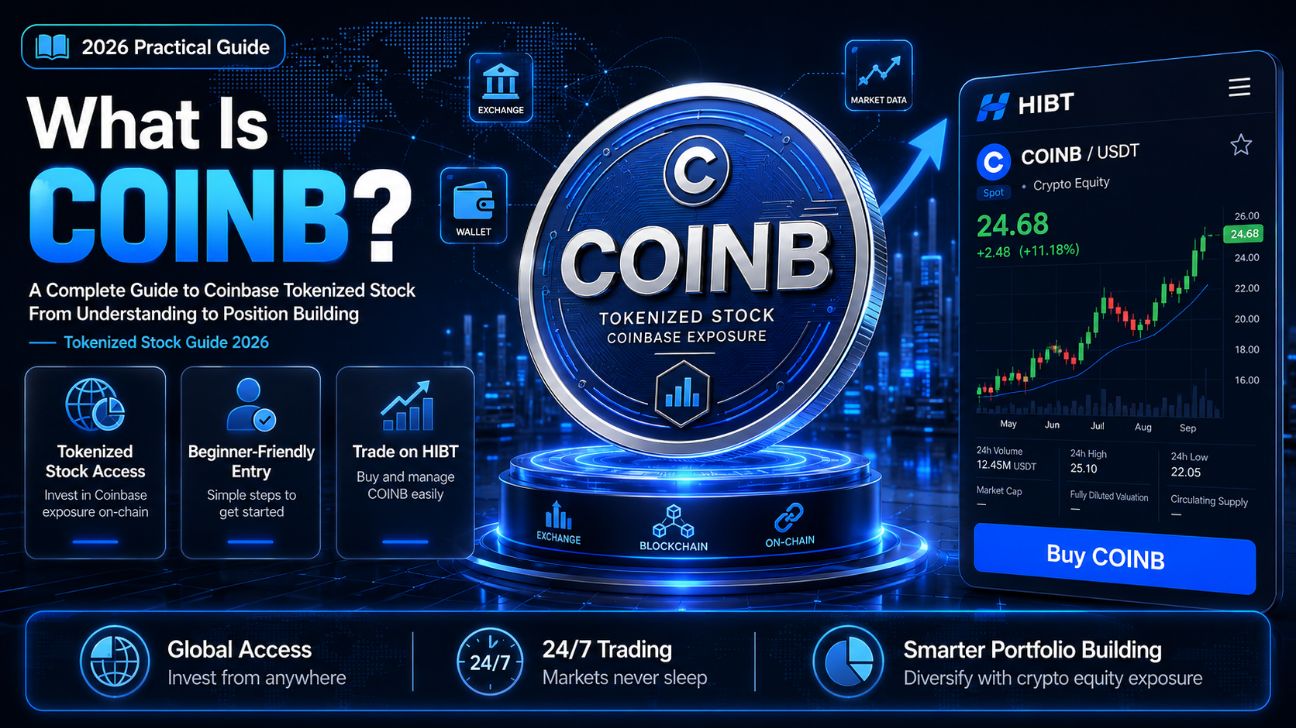
COINB is Coinbase Tokenized bStocks, a tokenized mapped asset providing economic exposure to Coinbase stock.
In other words, COINB is not an independent crypto project, nor is it a new public-chain token officially issued by Coinbase. Its core value does not come from a "token issuance narrative," but from the share price performance of the listed company Coinbase.
According to the official HIBT announcement, the COINB trading pair is COINB/USDT, it runs on the BSC network, trading opened at 04:00 UTC on July 9, 2026, and withdrawals opened at 04:00 UTC on July 10, 2026. The announcement describes COINB as a tokenized bStock that provides economic exposure to Coinbase Tokenized bStocks.
Therefore, the correct understanding is:
- COIN is a traditional U.S. stock;
- COINB is an on-chain tokenized stock asset;
- COINB's price is strongly correlated with COIN's stock price;
- But COINB is not the same as directly holding Coinbase shares in a traditional brokerage account.
2. How Tokenized Stocks Work
The core logic of tokenized stocks can be summarized as follows:
Real-world stock assets + custody mechanism + on-chain token + exchange liquidity.
Official bStocks documentation states that bStocks are tokenized securities providing full economic exposure to U.S. stocks and supporting 24/7 trading. Each bStock is backed by an equivalent amount of underlying stock and verified through Proof of Collateral. The documentation also explains that an SPV purchases and custodies the underlying stocks, while smart contracts mint bStocks 1:1 on BNB Smart Chain, with corporate actions such as dividends and stock splits handled through the mechanism.
However, one critical point must be emphasized:
Tokenized stocks provide economic exposure; they do not make you a direct shareholder of the underlying listed company.
The official bStocks disclaimer explicitly states that bStocks are issued by BTECH Holdings Ltd and represent an interest in the underlying securities, but do not entitle the holder to direct ownership of the underlying listed company's stock.
Therefore, COINB is better understood this way:
It allows users to gain economic exposure tied to Coinbase's stock price through a crypto trading platform, rather than placing them directly on Nasdaq's shareholder register.
3. Three Reasons for Crypto Newcomers to Consider COINB
First, Coinbase itself is crypto industry infrastructure.
Coinbase is not an ordinary internet company; it is a U.S.-listed crypto exchange whose business spans consumer trading apps, institutional services through Coinbase Prime, developer platforms, custody, stablecoin infrastructure, and global settlement. Coinbase's investor relations page shows that as of March 31, 2026, quarterly trading volume reached $202 billion and platform assets totaled $294 billion.
Second, trading COINB aligns more closely with crypto-native habits.
Buying COIN stock traditionally usually requires:
- Opening a U.S. stock brokerage account;
- Completing brokerage KYC;
- Handling USD deposits;
- Being constrained by U.S. stock trading hours;
- Navigating regional barriers to securities accounts.
On HIBT, the user journey is:
- Register an account;
- Complete KYC;
- Deposit or purchase USDT;
- Enter the COINB/USDT trading pair;
- Execute trades using limit or market orders.
This is far more intuitive for crypto users already familiar with USDT and spot trading.
Third, COINB offers more flexible trading hours.
Traditional U.S. stocks have fixed market open and close times, whereas bStocks' official positioning emphasizes 24/7 trading. For crypto users, this means positions can be adjusted even when U.S. markets are closed, based on BTC, ETH, regulatory news, Coinbase-specific developments, and overall market sentiment.
But this is a double-edged sword: flexible trading brings convenience, but also carries risks of premium, discount, and emotional chasing.
II. What Exactly Is COINB? Deconstructing the Underlying Assets and Pricing Mechanism
To understand COINB, two questions matter most:
First, what is the source of its value?
Second, is it really pegged 1:1 to Coinbase stock?
1. How Do Coinbase Fundamentals Affect COINB?
COINB's underlying logic is not an "on-chain narrative," but the Coinbase company itself.
Coinbase's value primarily comes from the following areas:
1. Trading Fee Revenue
When trading in major assets like BTC, ETH, and SOL is active, Coinbase's trading volume typically rises. Higher trading volume means more room for transaction fee revenue growth.
Therefore, COINB is highly correlated with the crypto market cycle.
When the market enters a bull phase:
- BTC price rises;
- Retail trading becomes active;
- Institutional capital flows in;
- Coinbase platform trading volume increases;
- Market expectations for Coinbase revenue growth improve;
- COIN stock may benefit;
- COINB may rise in tandem.
When the market enters a bear phase:
- Trading volume declines;
- User activity drops;
- Fee revenue comes under pressure;
- Stock valuation compresses;
- COINB may also fall.
2. ETF Custody and Institutional Business
Coinbase is more than a retail trading platform; it also serves institutional clients. Coinbase's investor relations page shows that its business includes Coinbase Prime, custody, stablecoin infrastructure, and global settlement.
For COINB investors, the more stable the institutional business, the less Coinbase's revenue structure depends on a single retail trading cycle, which can improve long-term valuation stability.
3. Base L2 Ecosystem
Base is a major on-chain ecosystem driven by Coinbase. DeFiLlama data shows that Base has become an active network with metrics covering stablecoins, market cap, on-chain fees, DEX trading volume, active addresses, and transaction counts.
For Coinbase, the significance of Base is not merely "building a chain," but connecting exchange users, wallet users, developers, on-chain applications, and stablecoin use cases. If the Base ecosystem continues to grow, the market may view Coinbase as an integrated company — "exchange + on-chain financial gateway + developer platform" — rather than just a place to buy and sell crypto.
4. Derivatives and International Expansion
In 2026, Coinbase launched futures contracts in Europe. Its official blog stated that European users can access regulated crypto futures, Mag7 + Crypto Equity Index Futures, and perpetual-like long-term futures products through Coinbase Advanced. Reuters also reported that Coinbase and Kalshi launched regulated crypto perpetual futures for U.S. investors in May 2026, with these products falling under the CFTC regulatory framework.
This shows Coinbase is expanding toward becoming a "comprehensive trading platform," and such business developments will affect market valuations of COIN stock and indirectly impact COINB.
2. Does COINB Equal 1:1 Holding of Coinbase Stock?
From a product design perspective, COINB tracks economic exposure to Coinbase stock; from the bStocks mechanism perspective, the underlying assets are backed by an equivalent value of stock with Proof of Collateral.
But newcomers must understand:
Price correlation does not mean zero deviation forever.
Short-term premiums or discounts can appear between COINB and COIN common stock due to:
- U.S. markets being closed while COINB continues to trade;
- BTC and ETH surging or crashing during U.S. market closures;
- Insufficient order book depth on COINB;
- Market sentiment front-running expectations for COIN's next-day open;
- Price asynchronicity across different platforms;
- Market makers adjusting inventory and risk exposure.
A simple example:
If BTC suddenly surges 8% after the U.S. market close, the market may expect Coinbase stock to gap up the next day, and COINB could rise on HIBT in advance. At this point, COINB's price may exceed the theoretical price implied by COIN's previous closing price.
Conversely, if negative regulatory news hits over the weekend before COIN common stock opens, COINB may fall first.
So newcomers should not simply assume:
"COINB will always equal COIN's stock price."
A more accurate understanding is:
COINB fluctuates around COIN's stock value over the long term, but in the short term it is influenced by crypto market sentiment, order book liquidity, U.S. market closure times, and platform trading depth.
3. How to Read the COINB/USDT Market Page?
After entering the COINB/USDT real-time market page on HIBT, newcomers should not stare only at the current price, but examine at least four dimensions. The HIBT Chinese market page shows that the COINB/USDT page includes the trading pair name, 24h high, 24h low, 24h volume, and a link to the trading interface.
1. Read the Candlestick Trend
Prioritize the 4-hour and daily timeframes; don't just look at the 1-minute chart.
A common newbie mistake: seeing a quick pump on the 1-minute chart and immediately buying at market price, only to watch the price pull back right after the purchase.
A more prudent approach is to check:
- Whether the daily chart is in an uptrend;
- Whether the 4-hour chart has broken key resistance;
- Whether the pullback holds the previous low;
- Whether the rise is accompanied by expanding volume.
2. Check Trading Volume
Rising prices with shrinking volume suggest weak buying interest.
A breakout above resistance with expanding volume indicates higher capital participation.
Tokenized stocks like COINB especially require attention to liquidity, because newly listed assets may not have order book depth comparable to BTC or ETH in the early stages.
3. Check Order Book Depth
Before buying, observe:
- Whether the bid-ask spread is too wide;
- Whether sell orders are clustered above;
- Whether buy orders provide support below;
- Whether your own order size would materially impact the price.
If the order book is thin, newcomers should use limit orders and avoid large market orders.
4. Compare with COIN Common Stock
COINB's core reference is COIN stock, so before trading, observe in parallel:
- COIN's previous closing price;
- Pre-market and after-hours performance;
- Daily BTC and ETH price action;
- Coinbase company news;
- Earnings report release dates;
- U.S. regulatory news.
As of the data verification date for this article, COIN's real-time price can be checked through securities market data tools; authors should update to the latest data before publishing.
III. COINB Investment Thesis: Valuation Under the 2026 Crypto Cycle
Investing in COINB is not simply buying a new token; it is answering one question:
Do you believe in Coinbase's position in the future crypto financial system?
1. Is COINB a Bet on Coinbase's Prospects or Crypto Market Beta?
Answer: both.
The first layer of COINB is Coinbase the company itself:
- Trading volume;
- Fee revenue;
- Custody business;
- Stablecoin-related revenue;
- Base ecosystem;
- Derivatives expansion;
- Compliance progress;
- Earnings performance.
The second layer is overall crypto market beta:
- Whether BTC is rising;
- Whether ETH is active;
- Whether ETFs are seeing continuous inflows;
- Whether altcoin trading is recovering;
- Whether on-chain activity is picking up;
- Whether market risk appetite is improving.
If BTC enters a strong bull market, Coinbase's trading volume and market attention usually increase, COIN stock may benefit, and COINB therefore carries the characteristics of a "leveraged crypto infrastructure asset."
But if Coinbase's own earnings miss expectations, or regulatory policy impacts the exchange business, COINB could come under pressure even if BTC performs well.
2. How Is COINB Different from BTC/ETH?
Holding BTC directly is investing in the core asset of the crypto market.
Holding ETH directly is investing in the smart contract ecosystem and on-chain application infrastructure.
Holding COINB is more like investing in:
Commercial infrastructure for the crypto industry.
It is not a native on-chain asset, but a "mapped equity interest in a crypto industry listed company."
The logic of the three is therefore different:
- BTC leans more toward digital gold and macro liquidity;
- ETH leans more toward on-chain ecosystem and application settlement layer;
- COINB leans more toward exchange, custody, compliance gateway, and institutionalization trends.
Some investors interpret COINB as a "crypto industry ETF." This has some intuitive value because Coinbase's revenue is indeed tied to crypto industry activity. But strictly speaking, COINB is not an ETF; it corresponds to only one company, so single-company operational risk remains.
A more accurate description is:
COINB is not a crypto industry ETF, but tokenized stock exposure to a crypto infrastructure company.
3. Key Catalysts Affecting COINB in 2026
1. U.S. Crypto Regulatory Clarity
If the U.S. provides clearer rules for exchanges, custody, stablecoins, token listings, and derivatives, compliant platforms like Coinbase may benefit.
But regulatory clarity does not mean no regulatory pressure. In its 2026 statement on Tokenized Securities, the SEC emphasized that tokenization does not change the applicability of securities law; tokenizable assets include stocks, bonds, notes, investment contracts, options, and security-based swaps. This means tokenized stocks have large growth potential, but compliance requirements will not disappear.
2. Coinbase Derivatives Business Progress
Derivatives are a key direction for trading platforms to increase revenue and user stickiness. Coinbase's official derivatives page shows its product line includes traditional futures, stock index futures, U.S. perpetual-like futures, and 24/7 trading.
If the derivatives business progresses smoothly, the market may assign Coinbase higher growth expectations.
3. Base Chain TVL and Activity
Data on Base's active addresses, transaction volume, stablecoin size, DEX trading volume, and on-chain revenue all influence the market's assessment of Coinbase's on-chain ecosystem strategy.
For COINB investors, observing Base means more than just looking at TVL; you should also check:
- Whether there are real users;
- Whether there are high-frequency applications;
- Whether stablecoins are growing;
- Whether developers continue to deploy;
- Whether revenue reflects Coinbase ecosystem value.
4. Coinbase Earnings Reports
Medium-term investors should pay special attention to Coinbase earnings reports.
Around earnings releases, COIN stock may experience significant volatility, and COINB may move in sync. Key items to watch:
- Total trading volume;
- Trading revenue;
- Subscription and services revenue;
- Institutional assets under custody;
- Operating expenses;
- Net profit;
- Management guidance for the next quarter.
4. How to Use COINB Price Prediction Tools?
HIBT provides a COINB price prediction page, which states that predictions are generated based on user feedback and display short-term and long-term price prediction data.
Newcomers should not treat such tools as "guaranteed future target prices," but as auxiliary planning tools.
Correct usage:
- Simulate returns under different growth rates;
- Help set take-profit zones;
- Gauge the market's imagination for long-term prices;
- Combine with COIN common stock trends, Coinbase earnings, and BTC market conditions to make decisions.
Incorrect usage:
- Going all-in because you saw a 2030 prediction price;
- Treating the prediction page as an official return guarantee;
- Looking only at ROI and ignoring risk;
- Not setting a stop-loss.
IV. Step-by-Step Guide: The Complete Path to Buying COINB on HIBT
This section is aimed at complete beginners. The focus is not on complex theory, but on explaining what to watch out for at each step from registration to holding.
1. Register a HIBT Account
Go to the HIBT official website or app and register with an email or phone number.
Newcomers are advised to complete three things immediately after registration:
- Set a strong login password;
- Enable Google Authenticator or other 2FA;
- Set an anti-phishing code.
Do not reuse passwords from other websites, and never send verification codes, login links, seed phrases, or private keys to anyone claiming to be "customer service."
2. Complete KYC Verification
HIBT articles explain that most exchanges require users to pass a certain KYC level before gaining withdrawal capabilities; the standard process usually includes registering an account, binding an email or phone number, uploading ID documents, waiting for review, and enabling multi-factor security verification. KYC purposes include anti-money laundering, anti-fraud, and account security.
Common reasons for KYC rejection include:
- Blurry ID photos;
- Expired documents;
- Name mismatch with the document;
- Uploading an unsupported document type;
- Residency restrictions;
- Poor lighting during facial recognition;
- Duplicate authentication across multiple accounts;
- Using a VPN causing abnormal region information.
Document requirements may vary by region. Users in mainland China, Southeast Asia, Europe, and the U.S. may differ in document type, address proof, and source-of-funds statements. Always follow the HIBT real-time page prompts and local laws and regulations.
3. Prepare USDT
Buying COINB usually requires holding USDT first.
There are two common deposit paths:
1. On-Chain USDT Deposit
Suitable for users who already have assets on other exchanges or in wallets.
Common networks include:
- TRC20;
- ERC20;
- BSC/BEP20;
- Polygon;
- Arbitrum;
- Optimism.
When selecting a network, newcomers must confirm:
The deposit network must exactly match the withdrawal network.
For example, if you withdraw USDT via TRC20 from another platform, you must select the USDT-TRC20 deposit address on HIBT. Choosing the wrong network can result in irreversible loss of assets.
The HIBT withdrawal guide also reminds users that different tokens run on different systems, and network selection must match both the platform and the receiving wallet. Do not blindly choose unfamiliar networks just to save on fees.
2. P2P or Quick Buy
Suitable for newcomers without USDT.
The advantage is simplicity; the disadvantages are:
- Exchange rates may be slightly higher;
- Payment methods are subject to regional restrictions;
- Need to pay attention to merchant reputation;
- Potential bank card risk control issues.
Newcomers are not advised to make large deposits on their first attempt. Start with 50–100 USDT to test the full process.
4. Enter the COINB/USDT Trading Pair
HIBT's digital asset trading tutorial explains that users usually obtain USDT through deposit or purchase, transfer USDT to the trading account, enter the spot trading page, search for the target trading pair (e.g., BTC/USDT), then select the order type, enter price and quantity, and complete the trade.
The process for buying COINB is analogous:
- Log in to HIBT;
- Confirm USDT is in your account;
- Enter spot trading;
- Search for COINB;
- Select COINB/USDT;
- Confirm it is spot trading, not futures trading;
- Choose limit order or market order;
- Enter the purchase amount;
- Confirm fees, execution price, and quantity;
- After placing the order, check trade history and holdings.
5. Limit Order vs. Market Order: How to Choose?
Beginners Should Prioritize Limit Orders
Limit orders are suitable for:
- Thin order books;
- Not wanting to chase highs;
- Wanting to buy at a specific price;
- Larger trade sizes;
- Wanting to control slippage.
For example, if COINB is currently at 150 USDT and you want to buy on a pullback to 145 USDT, you can place a limit order at 145 USDT.
Market Orders Are Only for Small, Fast Trades
Market orders are suitable for:
- Very small amounts;
- Sufficient order book depth;
- Willingness to accept the immediate execution price;
- Rapidly changing market conditions.
But for newly listed tokenized stocks, market orders can produce slippage. Newcomers should not place large market orders when the order book is thin.
6. How to Set Take-Profit and Stop-Loss?
HIBT trading tutorials mention that order information displays order time, trading pair, trading volume, and take-profit/stop-loss settings.
Newcomers should think through before buying:
- What is the reason for buying?
- What is the maximum tolerable loss?
- At what price will you stop loss?
- At what prices will you take profit in stages?
- What if COIN common stock earnings miss badly?
- What if BTC suddenly crashes?
A simple strategy is:
- Short-term trades: consider stopping loss at 5%–8% loss;
- Medium-term trades: reduce position only after breaking key support;
- Long-term trades: buy in batches, never go all-in at once;
- After 20%–30% profit, consider recovering part of the principal.
7. How to Manage Your Position After Buying?
After buying COINB, don't just look at unrealized P&L; continuously monitor:
- COINB/USDT trading volume;
- COIN common stock price action;
- Coinbase earnings dates;
- BTC/ETH market conditions;
- Base chain data;
- HIBT announcements;
- bStocks Proof of Collateral;
- Whether corporate actions such as dividends, stock splits, or contract adjustments occur.
Special note: HIBT is the trading gateway; the underlying backing and Proof of Collateral mechanism for bStocks come from the bStocks system. Users should not simplistically equate "platform asset balance" with "verified underlying stock custody without risk." They should simultaneously review bStocks official disclosures, on-chain contracts, platform announcements, and exchange risk warnings.
8. Selling and Withdrawal Path
When you want to cash out COINB, the general path is:
- Sell COINB in the COINB/USDT trading pair;
- Receive USDT;
- Keep USDT on HIBT for further trading, or withdraw to a personal wallet;
- If fiat currency is needed, choose P2P or other compliant off-ramp paths;
- Handle tax reporting according to local legal requirements.
The HIBT withdrawal guide reminds users to confirm the asset, network, receiving address, withdrawal fee, credited amount, minimum withdrawal limit, daily limit, and processing time when withdrawing, and recommends a small test transfer for the first time.
V. Side-by-Side Comparison of Similar Tokenized Assets: COINB, CBRSB, or WDCB?
HIBT offers more than just COINB. For newcomers, the more important question is not "which one will definitely rise," but "what type of risk do I actually want to allocate to."
1. COINB vs CBRSB: Crypto Infrastructure vs. AI Chip Stock
CBRSB is Cerebras Tokenized bStocks. The HIBT announcement shows that CBRSB/USDT opened for trading at 03:00 UTC on July 9, 2026, on the BSC network, with the project description providing economic exposure to Cerebras Tokenized bStocks.
From a narrative perspective:
- COINB maps to Coinbase, with core themes being crypto exchange, custody, Base, and institutional services;
- CBRSB maps to Cerebras, with core themes being AI chips, compute power, wafer-scale computing, and AI infrastructure.
In 2026, if the market's main theme is crypto regulatory clarity, BTC ETF inflows, RWA, and on-chain finance, COINB is closer to crypto industry beta.
If the market's main theme is AI compute, AI chips, data centers, and inference demand, CBRSB is closer to the AI tech stock narrative.
Newcomers can read HIBT's article "What Is CBRSB?" to further understand the fundamental logic of AI chip tokenized stocks.
2. COINB vs WDCB: Crypto Cycle vs. Storage Hardware Cycle
WDCB is Western Digital Tokenized bStocks. The HIBT announcement shows that WDCB/USDT opened for trading at 09:00 UTC on July 8, 2026, on the BSC network, with the project description providing economic exposure to Western Digital Tokenized bStocks.
Western Digital belongs to the storage hardware sector, influenced by factors including:
- NAND flash prices;
- HDD demand;
- Data center expansion;
- AI storage demand;
- PC and consumer electronics cycles;
- Enterprise storage orders.
COINB's cycle is closer to crypto trading and the regulatory environment, while WDCB's cycle is closer to the semiconductor and storage hardware industry.
Newcomers can read HIBT's article "What Is WDCB?" to understand the investment logic of storage giant tokenized stocks.
3. Three Portfolio Allocation Approaches
Conservative: COINB-Focused
Suitable for:
- Those bullish on crypto's long-term development;
- Those who don't want to buy too many small-cap tokens;
- Those wanting exposure to crypto infrastructure companies;
- Those who can accept stock-level volatility but not extreme altcoin volatility.
Reference allocation:
- COINB: 70%;
- USDT: 30%.
Growth: Balanced COINB + CBRSB
Suitable for:
- Those bullish on both crypto and AI;
- Those willing to take on higher tech stock volatility;
- Those with some trading experience;
- Those who can handle earnings and news-driven volatility.
Reference allocation:
- COINB: 50%;
- CBRSB: 30%;
- USDT: 20%.
Aggressive: Small Position in WDCB
Suitable for:
- Those who understand storage hardware cycles;
- Those who can withstand larger drawdowns;
- Those willing to rotate across sectors;
- Those who don't bet all capital on a single narrative.
Reference allocation:
- COINB: 40%;
- CBRSB: 30%;
- WDCB: 20%;
- USDT: 10%.
The above ratios are educational examples only and do not constitute investment advice. For a first trade, newcomers are advised to test the workflow with a small amount rather than building a complex portfolio from the start.
4. How to Understand HIBT Fee Advantages?
HIBT's futures trading fee schedule states that the maker fee is 0.03% and the taker fee is 0.05%, with fees charged at the time of order execution.
Newcomers should understand Maker and Taker:
- A maker typically places limit orders, providing liquidity to the market;
- A taker typically executes at market price or immediately takes liquidity from the order book, consuming market liquidity.
If you are not in a hurry to trade, limit orders are usually better for controlling price and slippage. However, the specific COINB spot fees, promotional rates, VIP discounts, and actual execution costs should be based on the HIBT trading page's real-time display.
VI. Full Risk Landscape: 6 Pitfalls You Must Know Before Investing in COINB
COINB looks like a hybrid of "stock + crypto trading," but newcomers must look beyond convenience and examine the risks.
1. Regulatory Policy Risk
Tokenized stocks sit at the intersection of traditional securities law and crypto asset regulation.
The SEC emphasized in its Tokenized Securities guidance that tokenized securities may still be subject to securities regulation and investor protection rules. ESMA's MiCA page also states that the EU MiCA framework aims to enhance market integrity, financial stability, and consumer protection by regulating crypto-asset public offerings and service provision.
This means:
- Users in some regions may be unable to trade;
- Platforms may adjust service scope;
- Products may be suspended due to regulatory changes;
- Tokenized stocks may face stricter disclosure requirements;
- Users are obligated to comply with local laws.
HIBT's page shows its compliance license section includes U.S. MSB, Canada MSB, and Australian financial services license statements. But note that HIBT's U.S. MSB statement specifically clarifies that MSB registration does not represent approval, endorsement, certification, or recommendation by FinCEN, the U.S. Treasury, or any U.S. government agency of HIBT or its products and services.
Therefore, newcomers should not equate "having a registration statement" with "being risk-free."
2. Price Depeg and Liquidity Risk
COINB's price may deviate from COIN common stock during U.S. market closures.
A typical risk is:
BTC surges over the weekend, COINB is chased higher by the market, and the price is significantly above theoretical value. When U.S. markets open, COIN common stock does not rise in tandem, the COINB premium compresses, and newcomers who bought at the high suffer short-term losses.
Another scenario:
During market panic, COINB liquidity drops, sell orders drive the price temporarily below theoretical value, and if you are forced to stop loss, you may sell in a discount zone.
Mitigation methods:
- Check order book depth before buying;
- Don't chase market orders during extreme sentiment;
- Control position size during U.S. market closures;
- Compare COIN common stock and COINB prices;
- Set reasonable stop-losses and avoid high leverage.
3. Platform Counterparty Risk
Trading COINB on HIBT means assuming centralized exchange counterparty risks:
- Account security risk;
- Platform operational risk;
- Deposit and withdrawal suspension risk;
- Matching system anomaly risk;
- Risk control misjudgment risk;
- Asset custody transparency deficiency risk.
HIBT's own withdrawal guide also reminds users that assets held on an exchange are essentially account balances, and users do not control the private keys of the corresponding on-chain addresses. Therefore, for long-term large holdings, one must understand the meaning of "Not your keys, not your coins."
For newcomers, the recommendations are:
- Start with small test amounts;
- Don't keep all funds on a single platform;
- Enable 2FA;
- Set withdrawal whitelist;
- Regularly check login devices;
- Don't click unknown links;
- Consider diversifying management for large long-term holdings.
4. Tax Compliance Risk
Different countries treat tokenized stocks, digital assets, capital gains, and security tokens differently for tax purposes.
The IRS digital assets page states that taxpayers may need to report cryptocurrency, NFT, and other digital asset transactions on tax returns, and digital asset income carries tax obligations.
For U.S. users, COINB-related transactions may involve capital gains, income recognition, cost basis recording, and other issues.
For users in mainland China, virtual currency trading and related financial activities are subject to strict regulatory restrictions. Users must pay special attention to local regulations and should not interpret this article as any form of trading advice.
For users in Southeast Asia, reporting rules for digital assets and foreign investment income vary significantly by country; consult local professional tax advisors.
5. Leverage and Futures Misoperation Risk
One of the most dangerous mistakes newcomers make is intending to buy spot COINB but accidentally entering the futures page.
With spot purchases, the worst case is an unrealized loss due to price decline.
Futures trading with high leverage can result in liquidation due to short-term volatility.
Reuters, in its report on Coinbase and Kalshi launching regulated crypto perpetual futures, also warned that perpetual futures allow high leverage, and even slight adverse moves can rapidly amplify losses, posing high risk to retail investors.
Newcomers must confirm before trading:
- The current page is spot, not futures;
- The trading pair is COINB/USDT, not a fake copycat;
- Leverage is not enabled;
- Borrowed funds are not being used;
- Stop-loss is not treated as optional.
6. Scam and Counterfeit Risk
As a new asset, COINB may be exploited through fake links, fake customer service, fake apps, and fake airdrops.
Common scams include:
- Fake HIBT websites;
- Fake COINB airdrops;
- Private messages from "customer service" demanding transfers;
- Counterfeit trading pages;
- Inducing wallet connection and authorization;
- Fake BSC contracts;
- "Internal subscription links" posted in groups.
HIBT's official verification page explains that users can verify the authenticity of HIBT staff by entering an account or email to prevent phishing.
Security principles:
- Only log in through official channels;
- Do not trade through unfamiliar links from communities;
- Never provide verification codes to anyone;
- Never transfer funds to "customer service";
- Do not connect to unfamiliar DApps;
- Verify the BSC contract address from official COINB announcements;
- Do a small test transfer for the first withdrawal or on-chain transaction.
VII. COINB Action Strategies for Different Investor Types
Different users require completely different strategies. Don't copy someone else's position just because they made money.
1. Short-Term Traders: 1–30 Days
Short-term traders focus on volatility, not long-term value.
Watch for:
- COIN U.S. stock pre-market and after-hours moves;
- Daily BTC/ETH volatility;
- U.S. tech stock sentiment;
- Coinbase-related news;
- COINB order book depth;
- Whether RSI is overbought or oversold;
- Whether MACD shows a golden cross or death cross;
- Whether volume confirms a breakout.
Core discipline for short-term trading:
- No heavy overnight positions;
- No all-in bets on direction before earnings;
- No chasing when premiums are too high during U.S. market closures;
- Set a maximum loss limit before each trade;
- Single-trade loss does not exceed 1%–3% of account capital.
Suitable operation methods:
- Enter with limit orders;
- Follow breakouts with small positions;
- Stop loss promptly when support breaks;
- Take profit in stages; don't fantasize about selling the exact top.
2. Medium-Term Holders: 1–6 Months
Medium-term investors are better suited to event-driven trading.
Key events include:
- Coinbase quarterly earnings;
- BTC ETF fund flows;
- U.S. regulatory policy;
- Base chain ecosystem data;
- Derivatives business progress;
- COIN stock rating changes;
- Overall crypto market trading volume changes.
Medium-term strategies can include:
- Small observation positions before earnings;
- Add to positions after earnings confirm the trend;
- Buy in batches at key support levels;
- Trim in batches at resistance levels;
- Combine with HIBT's COINB price prediction tool for return simulation.
HIBT's COINB price prediction page can be used as an auxiliary tool, but the page also notes that predictions are generated based on user feedback and should not be treated as an investment guarantee.
3. Long-Term Allocators: 6+ Months
The core logic for long-term allocators buying COINB is:
Belief in Coinbase's long-term position in the future crypto financial infrastructure.
Worth monitoring:
- Whether Coinbase remains consistently profitable;
- Whether institutional custody business is growing;
- Whether Base continues to expand;
- Whether the stablecoin business is stable;
- Whether international markets are opening up;
- Whether regulatory risk is decreasing;
- Whether the crypto industry as a whole is entering a long-term growth phase.
Long-term allocation is not recommended all at once; dollar-cost averaging (DCA) in batches is preferred.
For example:
- First purchase: 25% of planned position;
- Buy another 25% on a 10% pullback;
- Buy another 25% after earnings confirm the trend;
- Reserve the final 25% for extreme market conditions.
Rebalancing strategy:
- If COINB surges and becomes too large a portfolio allocation, sell some to rebalance into USDT or BTC;
- If BTC surges but COINB lags, watch for catch-up opportunities;
- If Coinbase fundamentals deteriorate, do not average down indefinitely just because you are "long-term bullish."
4. Pure Beginner's Minimalist Path: Try with 100 USDT First
For complete newcomers, the most recommended approach is:
Get the workflow down first, rather than chasing maximum returns from day one.
Minimalist checklist:
- Register on HIBT;
- Complete KYC;
- Enable 2FA;
- Prepare 100 USDT;
- Enter COINB/USDT;
- Buy a small amount of COINB with a limit order;
- Check position P&L;
- Record the entry price;
- Set a mental stop-loss;
- Observe for 7 days without frequent trading.
What matters most for newcomers is not how much they earn the first time, but building the right habits:
- Don't go all-in;
- Don't borrow to trade;
- Don't chase pumps;
- Don't click random links;
- Don't use futures;
- Don't treat predictions as promises;
- Don't treat a single asset as your entire future.
VIII. Conclusion: COINB Is a Bridge, Not a Destination
The significance of COINB is not merely giving crypto users another trading instrument.
More importantly, it lets newcomers see a trend:
Traditional financial assets are entering crypto trading venues, and crypto users are also entering traditional asset markets such as stocks, ETFs, bonds, and gold.
This is the convergence of TradFi and Crypto, and the underlying logic behind the long-term existence of the RWA sector.
COINB connects:
- Coinbase, the U.S.-listed public company;
- The bStocks tokenized security mechanism;
- On-chain issuance on BNB Smart Chain;
- HIBT spot trading gateway;
- The USDT funding system;
- The trading habits of global crypto users.
But investing in COINB is not the destination.
What truly matters is that users learn through COINB:
- How to understand tokenized stocks;
- How to distinguish common stock from mapped assets;
- How to evaluate underlying assets;
- How to judge premiums and discounts;
- How to manage platform risk;
- How to size positions;
- How to combine crypto and traditional assets in a portfolio.
Information Sources to Track Continuously
COINB holders are advised to monitor long-term:
- Coinbase investor relations page;
- Coinbase quarterly earnings;
- HIBT COINB/USDT real-time market data;
- HIBT platform announcements;
- bStocks Proof of Collateral;
- SEC and CFTC regulatory developments;
- Base chain TVL, active addresses, and trading volume;
- BTC and ETH market trends.
HIBT COINB/USDT real-time market page:
Pre-Investment Self-Check Checklist
Before buying COINB, ask yourself:
- Do I know COINB is not an independent cryptocurrency?
- Do I know COINB is not the same as directly holding COIN stock?
- Have I completed KYC?
- Is my USDT deposit path secure?
- Have I confirmed the trading pair is COINB/USDT?
- Am I on the spot page, not the futures page?
- Can I accept the maximum potential loss?
- Have I set a stop-loss?
- Do I understand tax and regulatory risks?
- Am I not putting all my capital into a single asset?
If the answer to any of these questions is no, you should not rush to place an order.
COINB is a bridge, not a destination. It is suitable for learning about RWAs, tokenized stocks, and cross-market asset allocation, but not suitable to be treated as a "guaranteed-profit tool."
IX. FAQ: Frequently Asked Questions About COINB
1. What is COINB?
COINB is Coinbase Tokenized bStocks, a tokenized stock asset providing economic exposure to Coinbase stock. It is not an ordinary cryptocurrency officially issued by Coinbase, nor is it an independent public-chain token.
2. Is COINB the Same as COIN Stock?
Not exactly. COIN is a Nasdaq-listed stock; COINB is an on-chain tokenized security providing economic exposure to Coinbase stock. Holding COINB is not the same as directly holding COIN stock in a traditional brokerage account.
3. Can COINB Be Traded 24/7?
bStocks' official positioning emphasizes 24/7 trading, and HIBT also provides the COINB/USDT trading gateway. Actual trading status, maintenance schedules, deposit/withdrawal status, and liquidity should be based on HIBT's real-time page.
4. Does COINB's Price Always Equal COIN Stock?
Not necessarily. COINB fluctuates around Coinbase's stock value over the long term, but in the short term it may be affected by U.S. market closures, crypto market sentiment, order book depth, platform liquidity, and premiums/discounts.
5. Is COINB Suitable for Newcomers?
If newcomers already understand spot trading, KYC, USDT deposits, limit orders, market orders, take-profit/stop-loss, and platform risks, they can learn with a small amount. But if they can't even distinguish spot from futures, direct buying is not recommended.
6. Is COINB Suitable for Long-Term Holding?
Long-term holding is premised on your belief in Coinbase's business growth, compliant exchange status, Base ecosystem, institutional custody, and the long-term development of the crypto industry. But long-term holding does not mean risk-free; fundamentals should be reviewed regularly.
7. Which Is Better: COINB or BTC/ETH?
There is no absolute answer. BTC is more like the core asset of the crypto market, ETH is more like on-chain application infrastructure, and COINB is more like exposure to a crypto industry listed company. The three have different risk sources and can be combined based on individual risk tolerance.
8. Do I Need a U.S. Stock Account to Buy COINB?
Trading COINB/USDT on HIBT usually does not require a traditional U.S. stock brokerage account, but it does require a HIBT account, KYC, and USDT. Specific eligibility requirements are subject to the HIBT page and local laws and regulations.
9. What Is the Biggest Risk of COINB?
Major risks include regulatory policy changes, price depeg, insufficient liquidity, platform counterparty risk, custody transparency, tax compliance, futures misoperation, and scams/counterfeits.
10. How Much Should a Newcomer Buy the First Time?
Pure newcomers are not advised to make large purchases. Start with 50–100 USDT to complete the workflow, and only consider increasing position size after confirming you can read the trading page, order history, P&L changes, and selling process.
About the Author
The author has long focused on crypto trading platforms, RWA tokenized assets, exchange SEO content development, and beginner investment education, and is skilled at breaking down complex financial products from four dimensions: product operations, platform data, asset logic, and risk disclosure. The focus of this article is not to encourage readers to blindly buy, but to help newcomers build the right mindset: understand the asset first, then decide whether to participate; control risk first, then consider returns.
Disclaimer
This article is for information sharing, market research, and investor education only. It does not constitute investment advice, trading advice, legal advice, tax advice, or financial planning advice. Information involving COINB, COIN, HIBT, bStocks, Coinbase, CBRSB, and WDCB may change with market conditions, platform announcements, regulatory policies, and product rules. Readers should refer to HIBT's official page, bStocks official disclosures, Coinbase investor relations page, regulatory public information, and local laws and regulations.
Tokenized stocks are high-risk financial products that may involve substantial price volatility, insufficient liquidity, underlying asset depeg, platform trading suspension, deposit and withdrawal delays, opaque custody mechanisms, complex tax reporting, regulatory restrictions, and principal loss risks. Any investment decision should be made independently by the reader based on their own risk tolerance. Do not borrow to invest, do not go all-in on a single asset, do not trade with high leverage, and do not believe any guaranteed return promises.